
THE HISTORY OF
The First Settlers
The story of this waterfront begins more than 400 years ago. Long before European settlers arrived, the Anacostan Indians had established the village of Tahoga on the banks of the Potomac, near where Rock Creek meets the river. The confluence made it a natural gathering place, rich with fish and well-positioned as a trading hub for the many Native American tribes living throughout the region.
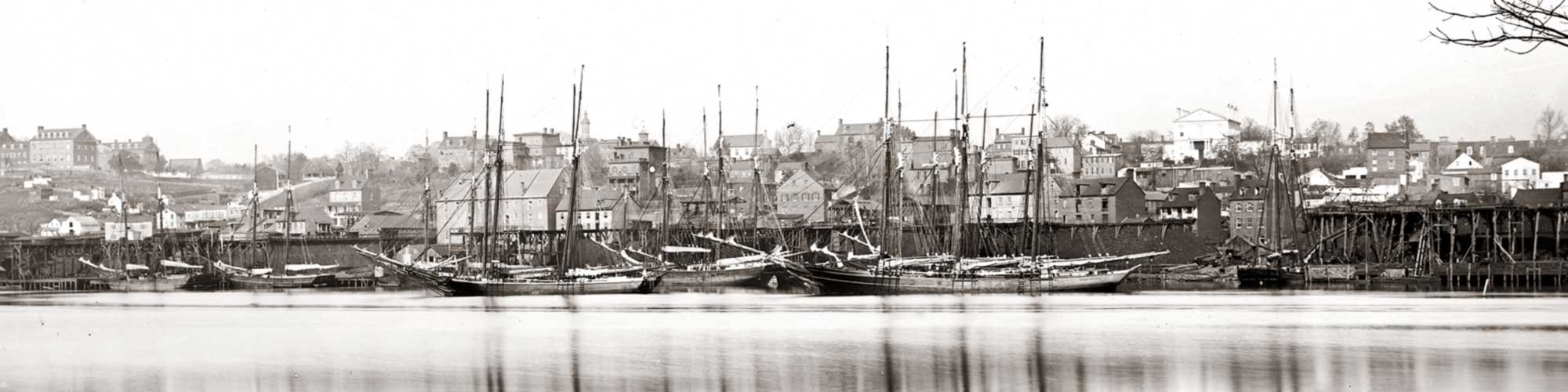
English explorers arrived in the early 1600s, claiming the land as part of the Province of Maryland. The European settlers who followed were drawn to the same spot the Anacostan had chosen, and they built a tobacco port there, with wharves and warehouses lining the river's edge. Georgetown was officially designated as an independent port city in 1751, and when the District of Columbia was established in 1791, Georgetown became part of the District, although it remained its own separate jurisdiction for nearly a century more.
the Port of Georgetown
An 18th Century Tobacco Port
Located at the northernmost navigable point on the Potomac, Georgetown became one of the busiest tobacco ports in the country. For most of the 18th century, nearly all the tobacco grown in Maryland and Virginia passed through this port on its way to market. But by century's end, the trade had shifted to the larger ports of Alexandria and Baltimore.
Grain and flour took tobacco's place in the early 1800s. The C&O Canal was built in the 1830s, just north of the port, creating a shipping route from the interior of the country. The Aqueduct Bridge was built across the Potomac to carry canal boats directly over the river to the Port of Alexandria.
19th Century Port in Decline
The Civil War years were hard on the port of Georgetown, and the decades that followed were harder still. Rail and road gradually replaced river transport for trade. The Long Bridge, built across the Potomac at 14th Street, blocked tall-masted ships from reaching Georgetown, and by the late 1800s, sedimentation in the river had made it unnavigable for large commercial vessels. Georgetown was no longer a port for shipping.
In 1871, Congress revoked Georgetown's independent charter, and by 1895, Georgetown was absorbed into the District of Columbia, and was no longer a separate legal entity.
An Industrial Waterfront: Early 20th Century Development
The Georgetown waterfront had a second life at the turn of the 20th century, this time as an industrial hub. The old tobacco wharves gave way to a new generation of businesses: the Capital Traction Company powerhouse, which supplied electricity to the District's streetcar system; the American Ice Company's large ice houses; and the Brennan Construction Company, which manufactured building materials for bridges and roads. A B&O Railroad spur was laid along Water Street to deliver coal to the Capital Traction plant. Part of that plant's massive concrete foundation remains today, buried beneath the lawn at the east end of the park.
Francis Scott Key Bridge was completed in 1923, and a decade later the old Aqueduct Bridge, by then converted for car traffic, was demolished. A remnant of its stone embankment remains along the shore. As the years passed, most of the factories closed or moved to the suburbs, and the remaining buildings were converted into flour and paper mills, a bottling company, and a rendering plant. The waterfront became increasingly neglected.
A Blighted Waterfront
In 1949, the Whitehurst Freeway was built directly over Water Street, visually cutting the waterfront from the historic neighborhood nearby. What had once been a working, living part of the city became an afterthought.
Things got worse before they got better. In the 1950s, the District of Columbia drew up plans for two inner-loop freeways and condemned ten acres of privately-owned waterfront land in Georgetown to make way for one of them. Public opposition to the project grew over the years, and by 1977 the city abandoned the freeway plans. But by law, the condemned land could only be used for transportation or for parks, so for years the Georgetown waterfront was used as a parking lot, and for storage for trash trucks and road salt.